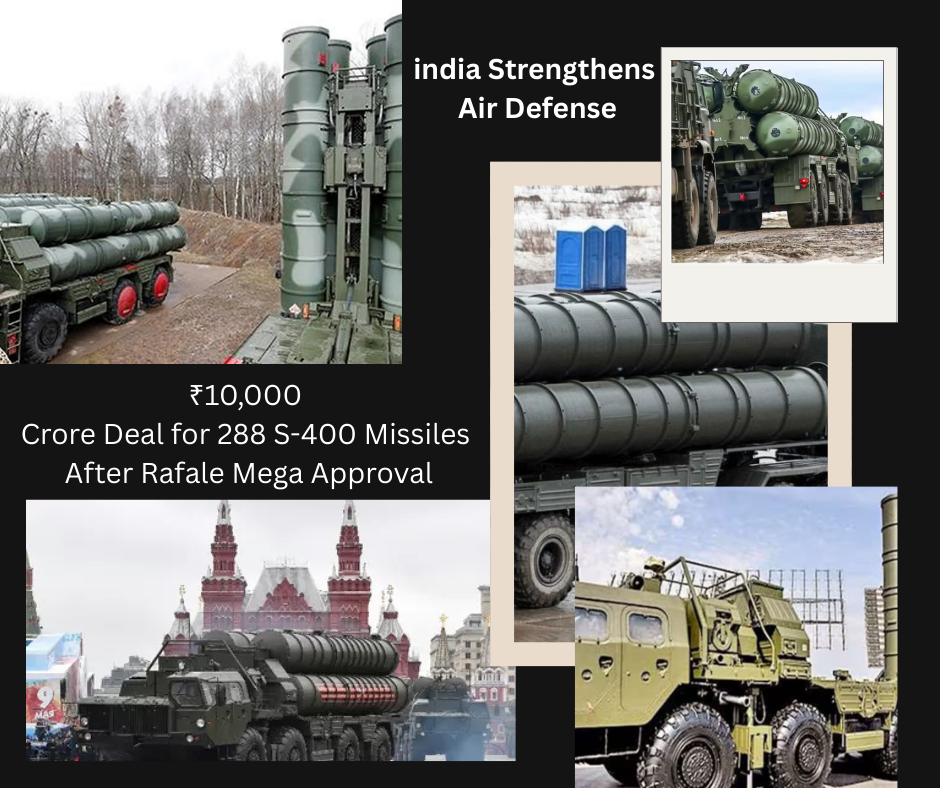
In a major boost to national security, India has approved the purchase of 288 additional S-400 missiles from Russia in a deal worth approximately ₹10,000 crore. The decision was cleared by the Defence Acquisition Council under the chairmanship of Defence Minister Rajnath Singh, reinforcing India’s commitment to strengthening its air defense network.
This approval comes shortly after India gave the green signal to a mega deal for 114 Dassault Rafale fighter jets from France — signaling a comprehensive strategy to enhance both offensive and defensive air capabilities.
A Strategic Move at a Crucial Time
India’s security environment remains sensitive, with evolving aerial threats along its borders. In such a scenario, air superiority and missile defense play a decisive role in deterrence and battlefield readiness.
The decision to procure 288 additional missiles for the S-400 Triumf system is being viewed as a proactive step to maintain operational preparedness. Reports indicate that during recent high-alert situations, including Operation Sindoor, S-400 systems were deployed effectively against hostile aircraft, drones, and surveillance platforms. The active use of missiles reduced stock levels, necessitating replenishment.
Ensuring a robust inventory is critical for sustained defense capability, particularly in scenarios involving prolonged aerial engagements.
What Makes the S-400 So Powerful?
The S-400 Triumf is widely regarded as one of the world’s most advanced long-range surface-to-air missile systems. Developed by Russia’s defense major Almaz-Antey, the system is designed to detect, track, and destroy a wide spectrum of airborne threats.
Key Capabilities:
- Engagement Range: 40 km to 400 km
- Targets: Fighter jets, stealth aircraft, drones, cruise missiles, ballistic missiles, and surveillance planes
- Multi-Target Tracking: Can track dozens of targets simultaneously
- High Accuracy: Advanced radar and fire control systems
One of its standout features is its layered missile system. The S-400 can deploy different types of missiles depending on the distance and altitude of incoming threats, making it a versatile shield for national airspace.
The Rafale + S-400 Combination: A Dual Shield Strategy
India’s defense modernization plan is clearly focused on balance. While the Rafale jets strengthen India’s strike capabilities with advanced avionics and multi-role combat features, the S-400 system provides a powerful defensive umbrella.
This dual approach ensures:
- Offensive air superiority
- Defensive airspace security
- Greater deterrence against potential aggression
By combining high-performance fighter aircraft with long-range missile defense systems, India is building a layered security architecture capable of handling both conventional and emerging threats.
Strategic Significance in Regional Context
Against Aerial Threats
With neighboring countries rapidly upgrading their air forces and drone capabilities, long-range air defense systems have become essential. The S-400’s ability to neutralize threats even before they enter Indian airspace gives the country a significant tactical advantage.
Deterrence Factor
Possession of advanced air defense systems acts as a strong deterrent. Potential adversaries must factor in the high probability of interception before planning any aerial intrusion.
Border Deployment Advantage
India has strategically deployed its S-400 units in sensitive border regions. This ensures coverage over critical air corridors and major military installations.
Technological Edge
The S-400 system offers several advanced features that elevate its battlefield performance:
- Advanced Radar Systems – Capable of detecting stealth targets.
- Mobile Launch Platforms – Truck-mounted systems enable rapid redeployment.
- Network Integration – Can be integrated with other air defense systems for a layered shield.
- Electronic Counter-Countermeasures (ECCM) – Resistant to electronic jamming.
These capabilities make it not just a missile launcher, but a comprehensive air defense ecosystem.
Financial and Diplomatic Dimensions
The ₹10,000 crore deal also underscores India’s continued defense partnership with Russia. Despite global geopolitical complexities and sanction-related discussions, India has consistently prioritized strategic autonomy in defense procurement.
While the investment is substantial, experts argue that national security infrastructure demands long-term financial commitment. Air defense readiness cannot be compromised, especially in a volatile security landscape.
Strengthening Military Readiness
Modern warfare increasingly involves drones, precision-guided munitions, and long-range missiles. Traditional air defense systems alone are no longer sufficient.
By expanding its S-400 missile inventory, India ensures:
- Continuous operational readiness
- Rapid response to aerial threats
- Reduced vulnerability during high-intensity conflicts
This move aligns with India’s broader goal of building a technologically advanced and future-ready military.
The Bigger Picture: India’s Defense Modernization Drive
Over the last decade, India has accelerated efforts to modernize its armed forces. From indigenous missile systems to international defense collaborations, the strategy revolves around creating a balanced and resilient defense ecosystem.
The additional S-400 missiles complement:
- Fighter aircraft modernization
- Indigenous air defense systems
- Surveillance and radar infrastructure upgrades
Together, these elements form a multi-layered shield protecting India’s airspace.
Conclusion: A Stronger Air Shield for a Safer India
The approval of 288 additional S-400 missiles marks a decisive step in reinforcing India’s national security architecture. Coming immediately after the approval of the Rafale mega deal, it reflects a clear, calculated strategy — strengthen defense, enhance deterrence, and maintain strategic superiority.
As regional security dynamics continue to evolve, India’s investment in advanced air defense systems sends a strong message: the nation is prepared, equipped, and committed to safeguarding its skies.
With this latest move, India not only boosts its missile inventory but also fortifies its long-term defense vision — building a stronger, more secure future.



Leave a Reply