Solar energy is evolving rapidly across the world. Traditional silicon panels (15–22% efficiency) are now approaching their practical limits. In this context, Perovskite and Perovskite-Silicon Tandem Solar Cells are considered one of the biggest breakthroughs for the future of solar power. Research laboratories have already achieved efficiencies of 30%+, and major manufacturers are preparing for commercial launches between 2026–2030.
1) What is Perovskite and Why is it Special?
Perovskite is a semiconductor material with a unique crystal structure (ABX₃ structure) that absorbs light very effectively.
Technical Features
High Absorption Coefficient – Generates more electricity even in very thin layers.
Tunable Bandgap – Chemical composition can be adjusted to capture different wavelengths of light.
Low-Temperature Manufacturing – Can be produced using less energy compared to silicon (roll-to-roll and ink-printing techniques).
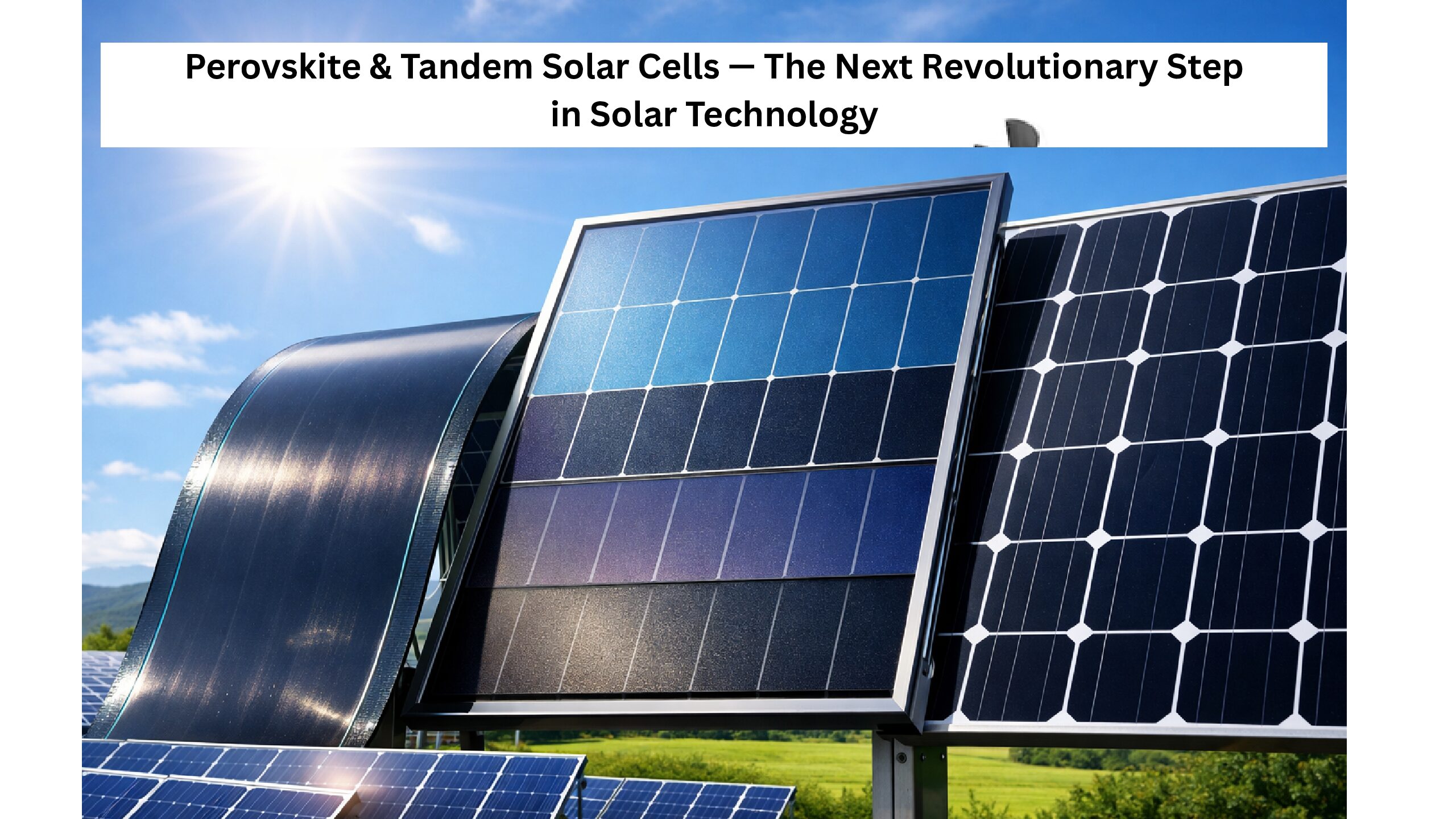
Lightweight and Flexible – Suitable for curved roofs, facades, and window integration.
2) What is a Tandem Solar Cell?
A Tandem (multi-junction) solar cell combines two different layers that work together:
Top Layer (Perovskite): Captures blue/visible light
This allows a larger portion of the solar spectrum to be utilized, increasing overall efficiency.
Efficiency
Traditional Silicon: ~20–23%
Perovskite-Silicon Tandem: 30–34% (lab level)
Theoretical Limit (multi-junction): 40%+
3) How Does It Work? (In Simple Terms)
Sunlight is like a rainbow with different energy levels.
A single-layer solar cell cannot efficiently capture the entire spectrum.
In a Tandem cell, each layer absorbs its “preferred” part of sunlight, resulting in higher total electricity generation.
4) Hidden but Important Points
(A) Stability Challenge
Perovskite can be sensitive to moisture, heat, and UV exposure.
Hidden Fact: Companies are developing advanced encapsulation and ion-migration control technologies to achieve a 20–25 year lifespan.
(B) Lead Content
Most perovskite formulations contain a small amount of lead.
Hidden Fact: Researchers are developing lead-free alternatives and improved recycling methods to reduce environmental risks.
(C) Retrofit Advantage
Tandem technology can potentially be added as a “top coating” to existing silicon production lines.
Hidden Fact: This could reduce factory upgrade costs and make panels more affordable in the future.
(D) Better Low-Light Performance
Perovskite performs better in low-light conditions (morning, evening, cloudy weather) compared to silicon.
Hidden Fact: Real-world energy gains may exceed lab expectations.
(E) Bifacial + Tandem = Game Changer
If Tandem panels are designed as bifacial modules, they can capture light from both front and rear sides, significantly boosting output.
Comparison Table: Silicon vs Perovskite vs Tandem Solar Cells
Feature / Parameter
Silicon Solar Panel
Perovskite Solar Cell
Perovskite-Silicon Tandem
Technology Status
Fully commercial, widely used
Research + limited pilot production
Advanced stage, rapid growth expected 2026–2030
Efficiency
~18–23% (commercial)
~22–26% (lab/pilot)
30–34% (lab record)
Theoretical Maximum Efficiency
~29%
~33%
40%+ (in multi-junction design)
Low-Light Performance
Average
Better
Much better
High-Temperature Performance
Output drops at high temperatures
Sensitive (stability challenge)
Depends on design
Weight
Heavy (glass-based)
Lightweight, thin-film
Moderate
Flexibility (Flexible Use)
No
Yes (flexible possible)
Limited (design dependent)
Manufacturing Cost
Stable but energy-intensive
Potentially lower
Higher initially, may decrease in future
Production Process
High-temperature wafer process
Low-temperature printing/coating
Silicon + top-layer coating
Lifespan
25–30 years
Still in testing phase
Target 25+ years (under development)
Environmental Concerns
Recycling available
Lead present in some formulas
Lead management required
Space Requirement
Requires more space
Requires less space
Higher output in less space
Price (₹/Watt)
Most affordable (currently)
Not yet finalized
Expensive initially, may balance in future
5) Emerging Applications
High-end rooftop and industrial solar plants
Building-Integrated Photovoltaics (BIPV) – glass and facades
Electric vehicle roofs
Solar windows (semi-transparent modules)
Off-grid and remote locations
6) Cost and Market Outlook (2026 Perspective)
Initial costs may be higher than traditional panels.
Major manufacturers aim for mass production between 2027–2030.
As production volume increases, cost per watt is expected to decrease.
7) Advantages and Limitations
Advantages
Potential for 30%+ efficiency
More power generation in limited space
Lightweight, flexible, design-friendly
Possibility of lower manufacturing costs in the future
Limitations
Long-term stability still under development
Environmental concerns related to lead content
Limited large-scale commercial availability at present
8) Is It Suitable for India?
In a sun-rich country like India, where rooftop space is limited and electricity demand is rapidly increasing, Perovskite-Silicon Tandem technology could be a game changer.
However, special testing and advanced encapsulation will be necessary to ensure durability in high-temperature climates.
Perovskite & Tandem Solar Cells are not just a new type of panel—they represent the next revolution in the solar industry.
With higher efficiency, better low-light performance, and the potential for lower future costs, they are poised to become one of the most powerful energy solutions of the coming decade.


Leave a Reply