
To understand photovoltaic (PV) power generation, it is essential to describe solar radiation, which serves as the primary input energy source. The Sun emits electromagnetic radiation similar to a black body with a surface temperature of approximately 6000 K. This emission is driven by nuclear fusion, where hydrogen is converted into helium. The Sun has a radius of about 1.39 × 10⁹ meters.
The total power of solar radiation received per unit area, perpendicular to the Sun’s rays at the mean Earth-Sun distance (1 astronomical unit or AU = 1.496 × 10¹¹ meters), is known as the solar constant (SC). The standard value of the solar constant is approximately 1.353 kW/m².
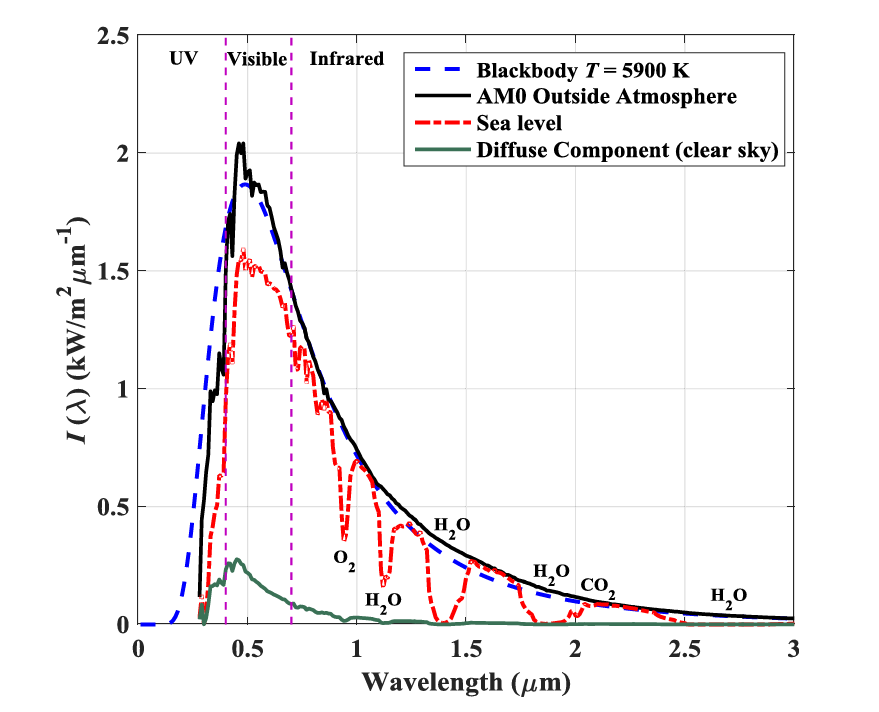
Like black body radiation, solar radiation spans a broad spectrum—from deep ultraviolet through visible light to far infrared. The power spectral distribution of sunlight indicates how this energy is spread across different wavelengths. The vertical axis of the spectral distribution graph represents spectral irradiance, I(λ), in units of W/m²/μm, while the horizontal axis shows the wavelength (λ) in micrometers (μm). The peak spectral irradiance occurs around λ = 0.5 μm.
As solar radiation passes through the Earth’s atmosphere, it is scattered and absorbed by air molecules. Gases such as O₂, H₂O, and CO₂ have specific absorption bands that reduce the intensity of sunlight reaching the surface. Nevertheless, the overall spectral shape remains similar to a black body curve at ~6000 K, often depicted as a dashed line in such plots.
Air Mass (AM) is a concept used to account for atmospheric effects on solar radiation. The solar intensity measured in space, without atmospheric influence, is termed Air Mass Zero (AM0), where 1 AM0 = 1 SC = 135.3 mW/cm². After passing through the Earth’s atmosphere at a perpendicular angle, the intensity is known as Air Mass One (AM1), with a typical value of 92.5 mW/cm². If the solar radiation strikes the Earth’s surface at an angle θ from the normal, the path length through the atmosphere increases, resulting in a higher air mass value.



Leave a Reply